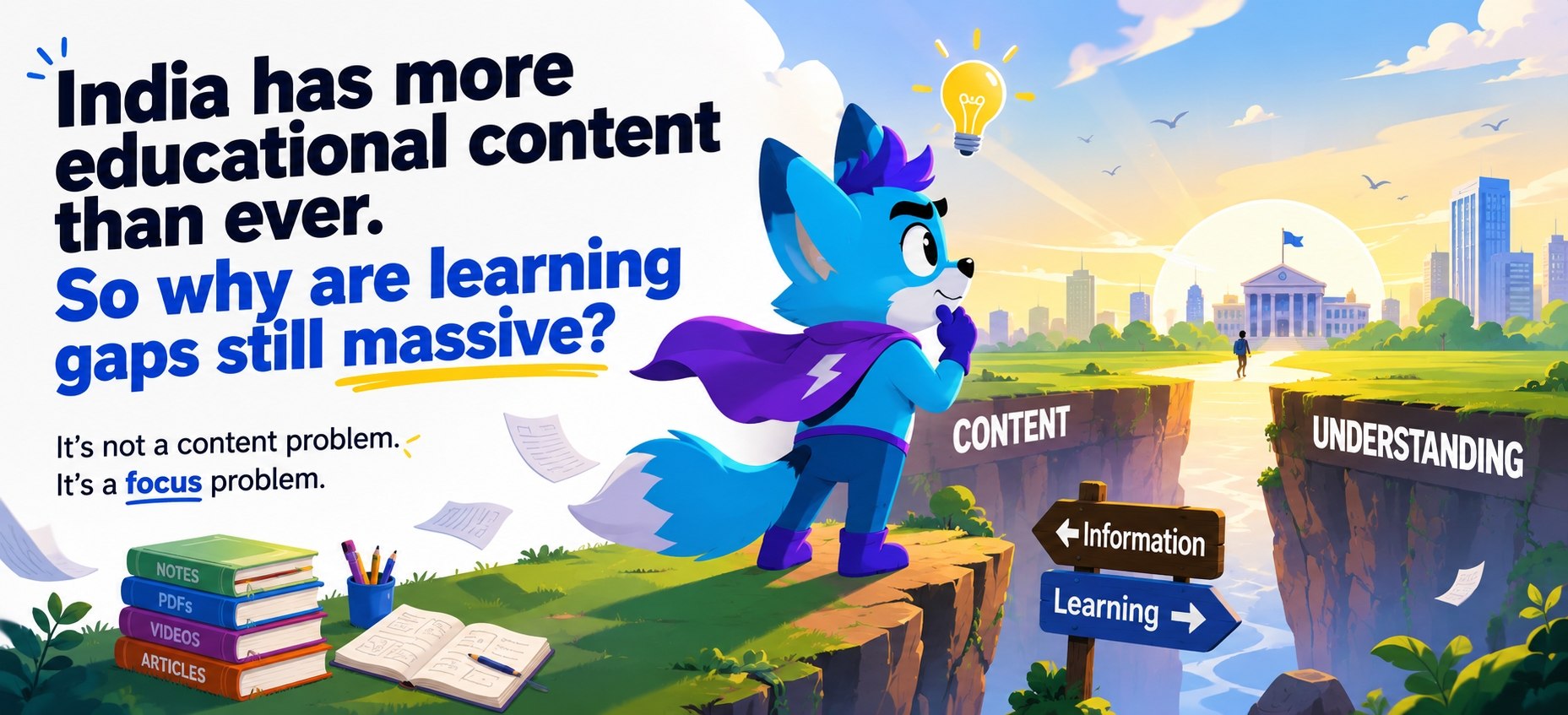
The content problem has mostly been solved
India does not lack educational content anymore.
A student preparing for UPSC can find hundreds of videos on Fundamental Rights. A TNPSC aspirant can find notes on the freedom struggle in Tamil and English. A Class 10 student can search for science explanations, diagrams, solved questions and revision PDFs in seconds.
The internet has made content abundant. In many cases, it has made content overwhelming.
Yet the learning gap has not disappeared. Students still forget what they studied. They still watch long videos without practicing. They still collect PDFs without finishing them. They still move from one resource to another without knowing what they truly understood.
That means the core problem has shifted.
It is no longer just, "Where can I find content?"
It is now, "How do I turn content into daily learning?"
More content does not automatically create better learning
Content is only the raw material of learning. A lesson becomes useful only when a student can understand it, recall it, apply it and revise it at the right time.
Most students are not failing because they are lazy. They are failing because the learning system around them is fragmented.
They watch one explanation on YouTube. They save a PDF from Telegram. They write notes in a notebook. They practice questions in a separate app. They track progress in their head. They revise only when exams get close.
Each piece may be useful on its own. But together, it often becomes a scattered routine.
The student has content, but not a learning loop.
The missing loop: learn, practice, remember
Strong learning usually follows a simple loop:
- Learn one clear concept.
- Practice questions immediately.
- See why an answer is right or wrong.
- Save mistakes.
- Revise before forgetting.
- Repeat tomorrow.
This loop is not glamorous, but it works.
The problem is that most digital learning tools focus heavily on the first step: content delivery. They help students watch, read or download. They do not always help students build a repeatable habit.
For Indian students, habit matters because the pressure is not one lesson. It is months of school syllabus, exam preparation, current affairs, revision and mock practice.
Learning gaps grow quietly when students miss this loop day after day.
Why passive learning feels productive
Passive learning is comfortable. Watching a good teacher explain a topic feels like progress. Highlighting notes feels like progress. Downloading a study plan feels like progress.
But exams test retrieval, not familiarity.
A student may feel that they know Fundamental Rights after watching a video. But when asked to distinguish Article 14, Article 19 and Article 21 in a tricky MCQ, the gap appears.
A student may feel that they understood the Indian National Movement. But when a question mixes events, years, leaders and organizations, memory becomes unreliable.
A Class 10 student may understand a science chapter while reading. But without practice, the exact concept can become unclear during a test.
This is why practice is not an add-on. Practice is where understanding becomes visible.
Indian students need smaller daily wins
Many learning products assume that students can sit for long, structured sessions every day. Some can. Most cannot.
Students juggle school, coaching, family expectations, travel, exams and distractions. Aspirants often balance preparation with college or work. A routine that depends on perfect motivation breaks quickly.
Daily learning has to be smaller and more realistic.
One focused lesson. One short quiz. One mistake review. One streak continued.
Small wins matter because they reduce friction. A student who studies for 15 useful minutes every day often builds more momentum than a student who waits for a perfect three-hour session that rarely happens.
The future of learning in India will not be won only by bigger content libraries. It will be won by products that help students return tomorrow.
Personalization should mean more than recommendations
Many platforms use personalization to recommend the next video or next course. That is useful, but incomplete.
True personalization should answer sharper questions:
What did the student just learn?
The next quiz should come from the actual lesson, not from a random topic bucket.
What did the student get wrong?
Mistakes should not vanish after the quiz. They should become revision material.
What should the student do tomorrow?
A daily learning product should reduce decision fatigue. Students should not need to rebuild their plan every morning.
What format does the student already use?
Some students learn from PDFs. Some from YouTube. Some from class notes. Some from a topic typed into a search box. A modern learning tool should convert those inputs into lessons, practice and revision.
That is the direction learning has to move toward: not more content for its own sake, but content converted into action.
Quizzes are not just tests
A good quiz is not only a scorecard. It is a learning instrument.
When a student answers a question, they are forced to retrieve information. When they see the explanation, they correct their mental model. When they review mistakes later, they strengthen memory.
This is especially important in India, where many exams are MCQ-heavy and concept-heavy at the same time. UPSC, TNPSC, SSC, Railway, school exams and board preparation all reward active recall.
The best public quiz pages should therefore not feel like static PDFs. They should feel like practice.
One question at a time. Clear options. Immediate explanation. Mistake review. A chance to retry with shuffled questions.
That is closer to how students actually improve.
The learning gap is really a habit gap
India's learning crisis is often discussed as a content access problem, a school quality problem or an exam pressure problem. All of those matter.
But for millions of students using digital tools today, there is another layer: the habit gap.
They need help starting. They need help continuing. They need help knowing what to revise. They need feedback after mistakes. They need a reason to return tomorrow.
The most important question for a learning platform is not simply:
"Can we explain this topic?"
It is:
"Can we help this student learn a little better every day?"
What MindGains is building toward
MindGains is built around a simple belief: learning should become a daily habit, not a one-time content binge.
That means combining focused lessons, AI-generated learning, quizzes, mistake revision, XP, streaks, leaderboards and current affairs into one loop.
The goal is not to replace teachers or books. The goal is to help students use what they already have more effectively.
A PDF should become a lesson. A YouTube video should become practice. A mistake should become revision. A day of learning should become momentum for the next day.
India already has the content.
The next challenge is turning that content into consistent learning.
Article → Quiz → App
Make Learning a Daily Habit.
Join the MindGains Early Access Waitlist to connect articles, quizzes, Daily Dose, Study Lab and mistake revision in one daily loop.
Join the Waitlist